
Patents · September 18, 2026
How to Protect a Medical Device Idea: Patents, Prior Art Searches & IP Strategy
Protecting a medical device idea starts with a prior art search, followed by a layered IP strategy that combines a utility patent, a design patent, and trade secrets, coordinated with the FDA regulatory timeline. Medical device innovators in Irvine, Orange County, and the Bay Area typically file a provisional patent application early to preserve rights while development and testing continue. This article builds on our medical device patent services.
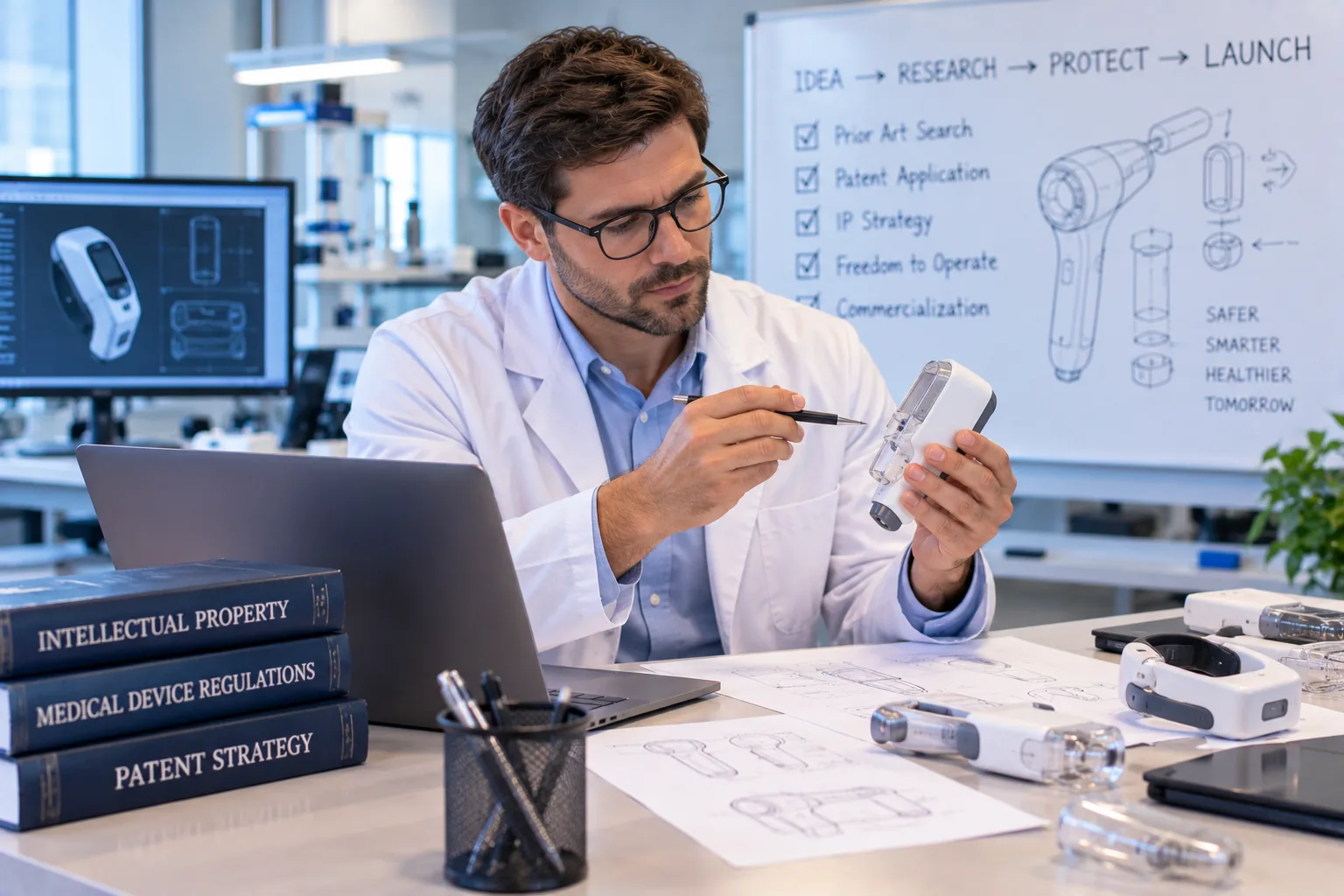
Why Medical Device Protection Requires a Layered IP Strategy
Medical devices rarely rely on a single form of intellectual property protection. A typical device might involve a novel mechanical mechanism (protected by a utility patent), a distinctive housing or user interface (protected by a design patent), proprietary manufacturing know-how (protected as a trade secret), and a product or company name (protected by a trademark). Building all four into a coordinated strategy from the earliest stages of development gives medical device companies the strongest possible protection as the product moves toward commercialization.
Step 1
Prior Art Search for Medical Devices
Before drafting any patent application, a thorough prior art search should review issued patents, published applications, medical journals, conference presentations, and competitor products. Medical device prior art often includes academic and clinical literature in addition to patents, since researchers frequently publish device concepts well before any patent application is filed. A well-executed search identifies which features of the device are genuinely novel and helps focus claim drafting on the aspects most likely to survive examination.
Step 2
Choosing the Right Patent Type
Utility patents protect how a medical device works, including its mechanism, materials, method of use, or method of manufacture. Design patents protect the ornamental, non-functional appearance of the device, such as its shape or surface ornamentation. Many medical device companies pursue both a utility patent covering the functional innovation and a design patent covering the distinctive appearance, since the two protect different aspects of the same product and can be pursued in parallel.
Step 3
Coordinating Patent Strategy With the FDA Regulatory Timeline
Medical devices generally cannot reach the market without navigating an FDA regulatory pathway, whether that is a 510(k) premarket notification, a De Novo request, or a Premarket Approval (PMA) application, depending on device classification. Because the FDA process and the patent process run on separate timelines, coordinating the two is essential. Filing a provisional patent application early preserves the priority date and allows the inventor to say “patent pending” while FDA submissions, clinical testing, and design iterations continue in parallel, without the pressure of an examined application moving forward before the device design is finalized.
Step 4
Filing Provisional vs. Non-Provisional for Medical Devices
Because medical devices often go through multiple design iterations during development and FDA testing, many inventors file a provisional patent application at each meaningful stage of development to capture new improvements, then consolidate these into a comprehensive non-provisional application once the device design stabilizes. This approach balances the need for early filing dates against the reality that medical device designs frequently change in response to testing, feedback, and regulatory requirements. Our guide to provisional vs. non-provisional patent applications compares the two filings in detail.
Step 5
International Protection Through the PCT
Medical device companies planning to sell outside the United States should consider filing an international application under the Patent Cooperation Treaty (PCT) within 12 months of the earliest priority filing. A PCT application preserves the ability to pursue patent protection in most major markets worldwide while deferring the cost of filing in each individual country for up to 30 months, giving companies more time to secure funding or confirm which international markets are worth pursuing.
Trade Secrets and NDAs for Medical Device Startups
Not every valuable detail of a medical device belongs in a public patent filing. Manufacturing tolerances, sourcing relationships, and certain software algorithms may be better protected as trade secrets, provided the company uses non-disclosure agreements (NDAs) and internal confidentiality practices consistently. Medical device founders meeting with contract manufacturers, investors, or potential licensing partners should have an NDA in place before disclosing sensitive technical details, since an unprotected disclosure can undermine both trade secret status and, in some cases, future patent rights.
University Tech Transfer and Medical Device Inventors
Medical device innovations that originate in a university lab setting typically involve a tech transfer office, which manages invention disclosures, patent filing decisions, and licensing terms on behalf of the institution. Inventors working within a university system should understand their institution’s invention assignment policies early, since ownership and licensing terms can significantly affect how a device is later commercialized, spun out into a startup, or licensed to an existing medical device company.
Common Mistakes Medical Device Inventors Make
Disclosing device details at conferences, in grant applications, or in academic publications before filing a patent application; assuming that FDA clearance or approval provides any intellectual property protection (it does not); delaying international PCT filing past the 12-month deadline; and failing to document design iterations and improvements as they occur, which can weaken later claims of inventorship or priority, are among the most common and preventable errors.
Common Questions
Frequently Asked Questions
No. FDA clearance or approval relates only to safety and effectiveness for marketing purposes; it provides no intellectual property protection whatsoever.
Yes, as long as the improvement itself is novel and non-obvious, even if the underlying device category already exists.
As early as the invention is sufficiently defined, since public disclosures, including academic publications and conference presentations, can start filing deadlines or eliminate patent rights outside the U.S.
Many medical device companies pursue both, since a utility patent protects function while a design patent protects appearance, and the two provide complementary layers of protection.